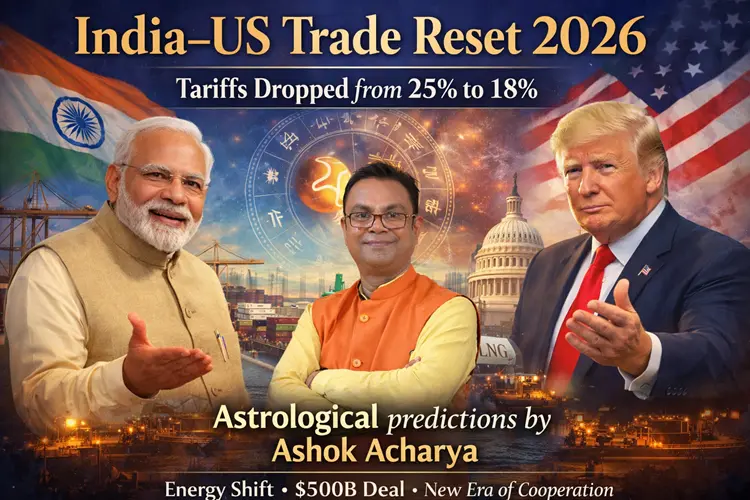
India and the United States took a decisive step toward reshaping their economic relationship. Following a direct conversation between Indian Prime Minister Narendra Modi and U.S. President Donald Trump, Washington announced a reduction in reciprocal tariffs on Indian exports—from 25% to 18%.
At first glance, the decision appears to be a technical trade adjustment. But when viewed in the broader context of global geopolitics, energy realignments, and long-term economic cycles, it represents something far more significant.
Veteran astrologer and spiritual analyst Ashok Acharya, who has studied global trends through both policy and planetary cycles for over three decades, believes this moment reflects a convergence of timing, strategy, and long-term intent.
“This is not a sudden event,” Acharya explains. “It is the outcome of accumulated decisions—economic, diplomatic, and karmic—reaching maturity at the same time.”
Understanding the February 3, 2026 Announcement
The 18% Reciprocal Tariff Reduction
The United States’ decision to lower reciprocal tariffs on Indian goods to 18% provides immediate relief to Indian exporters. Until recently, Indian industries had been preparing for potential tariff escalation, with some estimates suggesting duties could rise as high as 50% under certain trade enforcement scenarios.
Instead, the reduction places India in a favorable competitive position, particularly in sectors such as:
- Information Technology and IT-enabled services
- Pharmaceuticals and medical manufacturing
- Textiles and apparel
- Engineering and industrial goods
- Electronics and emerging manufacturing technologies
For American importers, the move lowers sourcing costs. For Indian exporters, it improves margins and predictability—two critical factors in long-term planning.
The Energy Dimension: Moving Beyond Russian Oil
One of the most closely watched elements of the agreement is India’s commitment to gradually discontinue the purchase of Russian crude oil.
Since 2022, India’s energy strategy has been under global scrutiny. While the country maintained that its purchases were driven by economic necessity, the geopolitical implications were unavoidable.
As part of the February 2026 understanding:
- India agreed to phase out Russian oil imports
- The United States withdrew an additional 25% energy-linked penalty tariff
- Both countries outlined a long-term energy and trade framework estimated at $500 billion, covering:
- Liquefied Natural Gas (LNG)
- Clean energy technologies
- Industrial coal and transitional fuels
- Strategic technology collaboration
From a policy standpoint, the shift strengthens India’s integration with Western energy systems while reducing exposure to geopolitical volatility.
The Long-Term Vision: Reducing Non-Tariff Barriers
Beyond tariffs, both governments acknowledged the need to address non-tariff barriers, which often pose greater challenges than duties themselves.
These include:
- Regulatory alignment
- Certification and compliance standards
- Market access procedures
- Data, technology, and intellectual property frameworks
While a complete zero-tariff environment remains a long-term aspiration, the February 3 announcement establishes a structured path toward smoother bilateral trade.
Why 2026 Is a Turning Point: An Astrological Lens
Ashok Acharya has been analyzing economic and political cycles through Vedic astrology since the early 1990s. According to him, 2026 marks a transition year—not only for India, but for global power dynamics.
Jupiter’s Transit and Expansion Through Cooperation
In Vedic astrology, Jupiter (Guru) governs expansion, wisdom, diplomacy, and sustainable growth. In 2026, Jupiter’s transit through Gemini—a sign associated with communication, trade, and adaptability—favors dialogue over confrontation.
Acharya notes that similar planetary configurations in the past have coincided with:
- Trade normalization after conflict-driven periods
- Expansion of knowledge economies
- Strategic alliances replacing short-term rivalries
“This Jupiter cycle rewards nations that invest in intelligence, communication, and shared growth rather than isolation,” he explains.
Saturn’s Influence: Structural Discipline
Saturn (Shani) is often misunderstood as restrictive, but in global astrology it represents discipline, restructuring, and long-term accountability.
India’s willingness to recalibrate its energy strategy reflects Saturn’s influence—prioritizing long-term stability over short-term convenience.
“Saturn supports nations that are willing to restructure outdated dependencies,” Acharya says. “The energy decision is difficult, but necessary for sustained sovereignty.”
Venus and Economic Balance
Venus (Shukra) governs value, prosperity, and equilibrium. Its favorable position during this period suggests economic growth rooted in balance rather than speculative excess.
This aligns with:
- Moderate but stable market optimism
- Increased focus on manufacturing and real assets
- Consumer confidence supported by trade stability
Economic Implications for India
Export Competitiveness and Investor Confidence
The tariff reduction enhances India’s appeal as a reliable export partner. Analysts expect positive effects across:
- Export-oriented manufacturing hubs
- MSMEs linked to global supply chains
- Technology and pharmaceutical clusters
Early market reactions indicate improved sentiment, particularly in indices linked to exports and international trade.
Energy Security and Strategic Autonomy
By diversifying energy imports and strengthening ties with the U.S. and allied markets, India reduces long-term exposure to sanctions, price volatility, and geopolitical pressure.
This strategic autonomy is likely to influence future trade negotiations beyond the U.S., including Europe and Asia-Pacific economies.
Impact on Wellness, Ayurveda, and Lifestyle Exports
India’s traditional strengths also stand to benefit. Reduced trade friction supports greater access to U.S. markets for:
- Ayurvedic and herbal wellness products
- Organic and sustainable textiles
- Yoga, meditation, and holistic wellness services
According to Acharya, this reflects a broader shift in global demand.
“The world is increasingly seeking balance—physical, mental, and environmental,” he says. “India’s wellness traditions align naturally with that demand.”
Sector-Wise Outlook
| Sector | Near-Term Impact | Long-Term Outlook |
| IT & Technology | Improved export margins | Innovation-led expansion |
| Energy | Diversified sourcing | Strategic stability |
| Manufacturing | Increased U.S. demand | Capacity and employment growth |
| Agriculture | Better market access | Price and demand stability |
| Financial Markets | Improved sentiment | Gradual wealth creation |
A Broader Global Context
The India–US trade reset comes at a time when the global economy is adjusting to:
- Slower growth in traditional markets
- Reassessment of supply chain dependencies
- Rising importance of strategic partnerships
Rather than signaling dominance, the February 2026 decision reflects a shared interest in predictability and cooperation.
Looking Ahead: The Decade from 2026 to 2036
Ashok Acharya views the current moment as the foundation for a longer cycle rather than a single event.
“The next ten years will favor nations that understand timing,” he says. “Growth will belong to those who align strategy with patience.”
Whether viewed through economic data or planetary cycles, the message is consistent: India’s global role is evolving—from participant to strategic anchor.
About the Author
Ashok Acharya is a globally respected astrologer, spiritual wellness coach, and thought leader with over 35 years of professional experience. Since 1990, he has advised individuals, institutions, and organizations on timing, decision-making, and long-term planning through Vedic wisdom and practical analysis.